MCFTM – Chief Encouragement Officer

,

In a bold move, Matt Davenport the President of Monarch Environmental promotes himself to C.E.O. Read the announcement:

Being the owner of any business big or small has its advantages and disadvantages. 

Some of the advantages can be a lot of fun. As the owner, you are given the freedom to design a logo, lead a team, create a vision, rebrand, be creative and so much more. 

Another huge advantage is the fact that you can promote yourself at any time! 

Therefore, I’m promoting myself today to Chief Encouragement Officer effective immediately. 

This promotion really does not have anything to do with COVID- 19. However, I must say the virus has highlighted the fact that I truly enjoy encouraging and pushing others to be their absolute best. Being raised by a pastor is partly the reason I often see more in other people than they see in themselves. 

This new title is somewhat kitschy I know. The aim is not marketing, it’s more about defining one of my key roles in a growing business and an everchanging world. 

My dad has always told me that optimists run the world. 

I don’t plan on running the world, but I do plan on being an optimistic encouraging leader to those I’m fortunate enough to know. 

A part of my new role, we will post a brief attempt at humor and insight in a weekly post called “Monarch’s Cure for the Mondays”. I’m hoping to encourage anyone paying attention that the best is yet to come! You were born for such a time as this. 

Sincerely, 

Matt Davenport C.E.O 

Chief Encouragement Officer - Monarch Cure for the Mondays

The Importance of Inspecting Trees to Prevent Hazards to Your Home – Our Guide

,

Trees may seem harmless upon first glance. You may not notice them every day, but trees are vital to your surroundings and are visual points of interest. Investing in the care of trees is highly beneficial for the community as they give environmental benefits and add beauty to the community, but failing to evaluate a tree’s condition can present liabilities and risk for your family and community. 

Why is Tree Maintenance Important? 

For one, trees that are placed close to a property can be a potential hazard to both personal and public safety. Landowners and homeowners alike are responsible for assessing the tree to maintain its upkeep. 

That means if you spot any defective part of a tree, it’s your duty to hire a professional arborist to nip the problem at its bud. After all, any structural failure from a tree can lead to personal injury or property damage, both of which can burn holes in your pocket. 

What Makes a Tree Hazardous? 

A tree can fail due to decay, old-age, or natural disasters causing pieces of it to fall off. However, it becomes most hazardous when there is a valuable target involved such as a structure, vehicle, or person. The directness of the target changes the degree of the risk, which also influences the corrective treatments that follow. 

A tree can also pose a threat if it blocks the vision of drivers, obstructs pathways, interferes with utilities or signs, or has roots causing issues with its surroundings (like raising sidewalks). This can be a hazard to the routine activities of people, which is why regular inspection is crucial to prevent possible risks occurring on properties or to people that are near the tree. 

What Causes a Tree to Fall? 

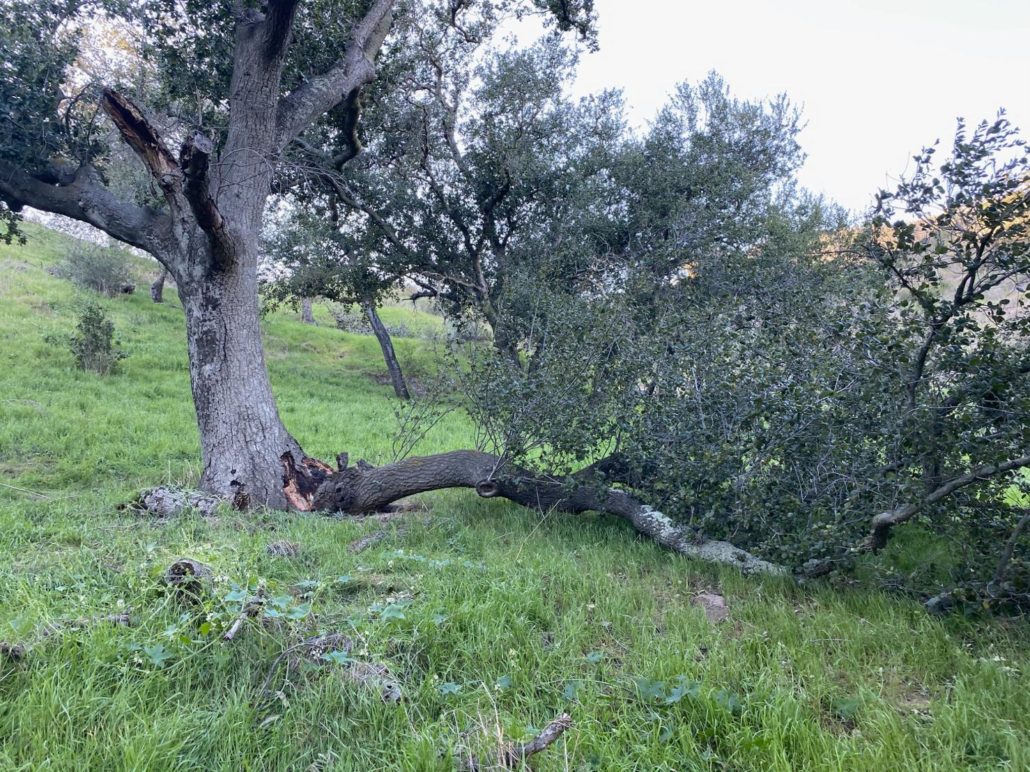
High winds and decay are a recipe for failure.

A tree that has partially fallen.

There are tree failures that are easily predictable, though most risks can be mitigated by keeping watch for any red flags. Pay attention to the following while you are inspecting your trees: 

Tree Health – You can foresee any structural problems by taking a closer look at the tree’s overall health. This includes the foliage color, foliage density, signs of infection, and it’s vigor. Some serious, tell-tale signs of a dying tree include large, dead branches, thin leaf coverings, oddly-shaped leaves, and fungus all over the bark. 

Tree Defects – Be sure to inspect the tree for any defects by thoroughly checking the crown and trunk down to the roots. A clear indication of a potential hazard is if there are dead branches along the tree’s crown, which are commonly called widowmakers. It’s an ominous name that serves as a warning to passers-by as defects can cause branches to fall even on a clear and calm day. 

Other signs that indicate impending issues are cracks and splits along the tree’s trunks. Root rot is one of the most important factors to consider, so be extra vigilant on inspecting the base of the trunk for any evidence of root defects like cracking, heaving soil, or growing mushrooms. 

Improper Pruning – Poor pruning techniques can weaken branches, which can lead to a decline of the tree’s health. 

Site Conditions – The planting location plays a significant role in a tree’s health as any construction within the tree’s root zone can compromise its ability to support the weight of the entire tree. 

Targets – These refer to the potential damage to valuable targets like people and property. A tree placed over a playground, near a sidewalk, or next to a driveway are samples of high-risk targets. 

Keep in mind that tree inspection is highly recommended before and after storms, heavy snowfall, flooding, and other natural calamities. 

Other Factors to Consider When Inspecting for Tree Failure 

For a more in-depth guide on what to consider when inspecting trees, refer to the table below: 

Site ConditionsBiotic and Abiotic FactorsHuman Activity
Depth of bedrockPathogens or diseases presentNearby tree removal
Soil typeInsect activity and severityExcavation removal of roots
Direction of prevailing windsDrought or flood effectsPaving obstructing roots
Erosion near the treeTree community makeup nearbyPoor pruning practices

Wind, storm, flood damagesInjuries due to mowers, car accidents, etc. 

Why You Should Rank Tree Defects

Ranking the severity of the tree’s condition can help you have a clearer picture of its overall health. This will allow you to determine the next best course of action to take – whether it just demands maintenance or complete removal. 

HighModerate
Cracks with decayCallus closing crack
Cracks with callus formingV-Shaped branch union with upturned bark
In-rolled bark widening the crackAny branch with up to 66% of side branches dead
4″ diameter or larger branch with crackBranch with a sharp bend
Two or more cracks in the same trunk or branchLopsided or unbalanced crown, especially if nearby trees were pruned or removed in the last ten years. 
Crack that allows independent movement on either side of the crack
V-shaped branch union with in-rolled bark
Cankers and rot with conks of shelf fungi
Cankers affecting more than 50% circumference
Canker connected to a crack
Dead tree
Dead branch
More than 50% of the root system severed within the drip line
Tree leaning > 45%
Learning tree with any defect on the trunk below the first branch above the ground

This should clue you in on the magnitude of the problem and help you reach the necessary measurements for mitigating the hazards. 

In Conclusion

Inspecting trees and foretelling any future hazard is an art and science. It takes a keen eye, proper training, experience, and the right tools to safely assess the health and condition of a tree to minimize the risk of fall damage and injury. 

That’s why assessing tree hazard is best left to the hands of a professional arborist. They have a deeper knowledge of tree biology and physiology, which supports their ability to evaluate the tree structure and its decay process. With all that combined, they can easily determine the tree’s growth pattern, its history, and how other environmental factors influence the tree’s integrity. 

Understanding the process behind tree hazard inspections can also help you spot red flags yourself. This will help you prevent any complications from growing out of hand as you can determine the best time to call a professional to cut the potential risks at its roots.

If you’re looking for a qualified tree risk assessor in Orange County, get in touch with us today to see how we can help.

A Simple & Easy Guide to Properly Watering Your Trees in Orange County

Trees are a vital part of our ecological system. They provide oxygen, improve air quality, contribute to climate amelioration, conserve water, preserve soil, and even support wildlife. On a more personal level, it helps to have trees around your property. They not only beautify your surroundings, but they also provide shade and tend to make the whole property a little more pleasant.

Taking care of your trees is paramount to ensuring that they stay healthy and stress-free for as long as possible. There is regular upkeep for your trees that you can practice to help maintain them for a very long time. If there’s one vital aspect of this upkeep that every homeowner can do, it is watering your trees properly. Watering your trees entails knowing the best time to do so, the amount of water you need, effective watering methods to employ, and the type of tree species you’re watering, among other things.

That said, here’s everything you need to know about how to water your trees properly. Follow our simple and easy guide to help your trees to thrive and live for as long as possible.

The best time to water your trees

The first step to consider is when is the best time to water your trees. There are no hard and fast rules when it comes to this step. Yet, you should consider the following information and factors:

1 – There’s no strict schedule for watering trees. However, the best time to water is usually in the morning or evening. This is the time when the roots have the best chance of absorbing most of the water.

2 – There’s also no specific frequency for watering trees. How often you should water typically depends on the size of your tree, soil conditions, and weather conditions. Know that newly planted trees require much more water than established ones.

3 – The best way to determine when trees need watering is to check the soil. Look for moist, not soggy, soil. Check the soil with a garden trowel to a depth of two inches, and if the soil is dry, your tree needs some water.

How much water should you give your trees?

When it comes to the amount of water for your trees, consider this rule of thumb: ten gallons of water are required for every inch of the tree’s diameter. Make use of a ruler at knee height to measure or use your best judgment. When watering a certain amount of water, consider the following tips:

1 – Slow and deep watering: Experts suggest that slow and deep watering is your best option, which is why drip lines are the preferred method of watering. For one, drip irrigation loses less water to evaporation as compared to overhead watering or sprinkler systems. This method allows the critical root zone to take up adequate moisture. When doing so, make sure to water the entire area beneath the tree’s canopy. As much as possible, the depth should be ten inches.

2 – Consistent watering: There’s no secret to this step. You just need to practice regular watering. This is because keeping the soil consistently moist is essential to healthy trees. Make sure not to allow the soil to dry out completely because it will make your trees stressed, which makes them more prone to disease and infestation.

3 – Watering all year round: It is important to water your trees year-round. Don’t forget to water your trees even during winter. Though they may be dormant, they are still growing. Make sure to water your trees, particularly when the air and soil temperatures are above 40°F.

Effective watering methods

The Davey Institute suggests that the best way to water trees is through the deep watering method. This helps to keep your trees hydrated, particularly during dry spells and prolonged drought. Here’s what you need to know:

1 – Deep watering method: Clearly, there is much more to your trees than what you see above the ground. The deep watering method entails delivering the water right to where trees need it the most – their roots. This method involves carrying water eight to twelve inches into the ground, instead of merely wetting the surface.

2 – Best way to water trees: Know that when you water the ground’s surface, much of the water evaporates before it even reaches the roots. The deep watering method is effective because it reaches the roots and has less water evaporation. Trees with shallow roots struggle to intake enough water from the top of the soil during dry periods and drought. Deep watering solves these problems. It encourages trees to grow a deep root system. It can also save you time and money while creating healthier trees.  

3 – Watering plants can be good for YOU and your trees: Apart from the benefits your trees can get from watering them, it can be very therapeutic for you to be out in nature and watering your plants. You can incorporate some stretching or isometric exercises with your watering routine. While you’re at it, you can even scout your plants for insects, caterpillars, and other tree-related problems. Other than that, you can also work on your Vitamin D levels as you water the trees under the sun. Dealing with trees and communing with nature can bring a peaceful rest to your chaotic day.

The steps and valuable information outlined above can help you to properly take care of and water your trees. It is essential that you practice regular watering because you now know the benefits that it will give to your trees, yourself, and your property.

If you’re are looking to learn more about watering your trees properly, get in touch with a certified arborist in Orange County to see how we can help.